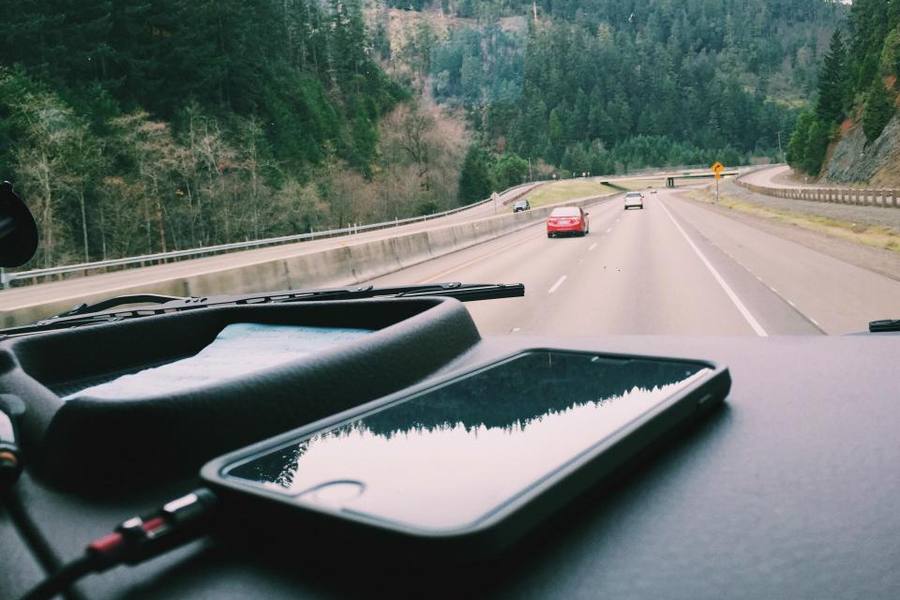
Image illustrative (photo de stock) ; ce n'est pas le produit exact.
Rear Coverage Is Not Optional
Rear-end collisions are among the commonest types of accident, and they are precisely the situation where you cannot see what happened.
A front-only camera records a collision you were already watching, and has nothing for the one that happens behind you — which is the one most likely to become a disputed claim.
That asymmetry is why two-camera systems are the sensible default rather than an upgrade, and the rear camera often earns its place before the front one does.
Plate Legibility Beats Resolution Claims
Resolution figures are heavily marketed and largely miss the point. What matters is whether a number plate is readable in the actual conditions you drive in.
Night performance, dynamic range against oncoming headlights, and lens quality all affect that far more than the number of pixels, and a 4K camera with poor low-light performance produces worse usable evidence than a good 1080p one at night.
The practical test is recording a normal evening drive and checking whether plates ahead are readable when paused, which no specification sheet answers.
Loop Recording And Event Locking
These record continuously and overwrite the oldest footage, which means an incident is preserved only if the file is locked before it gets overwritten.
An impact sensor locks the current file automatically when it detects a sudden movement, and a manual button does the same, and both can miss a slow-speed incident that does not trigger the sensor.
Knowing where the manual lock button is, and using it immediately after anything notable, is the habit that makes a dash cam useful rather than theoretically useful.
Parking Mode And Power
Parking mode records while the car is off, capturing damage in car parks, and it requires continuous power the accessory socket does not provide when the ignition is off.
A hardwire kit connects to the fuse box with a voltage cut-off that stops drawing power before the battery is too low to start the car, which is the essential safety feature.
Without that cut-off, a dash cam left recording can flatten a battery overnight, and hardwiring without one is genuinely risky rather than merely inadvisable.
Heat, Cards And Reliability
Windscreens get extremely hot in summer, and heat is the commonest cause of dash cam failure. Capacitor-based cameras tolerate heat far better than battery-based ones, which can swell.
Memory cards in dash cams are written to constantly and wear out, and a card that has silently failed means no recording at all when it matters.
High-endurance cards designed for continuous recording last considerably longer, and checking that footage is actually being recorded once a month takes a minute and prevents the worst outcome.
Mounting position deserves thought because it affects both the recording and the legality of the installation. Behind the rear view mirror keeps the camera out of the driver's sightline while giving it a clear view through the area the wipers sweep, which matters in rain. Many jurisdictions restrict how much of the windscreen may be obstructed, and a camera stuck in the middle of the glass is both a distraction and potentially an offence.
The Verdict
A genuinely worthwhile piece of equipment, with rear coverage mattering more than most people expect and plate legibility mattering more than resolution figures.
Parking mode needs a hardwire kit with voltage cut-off, heat kills battery-based units, and cards wear out silently.
Check your card once a month. A dash cam with a failed card records nothing, and you find out at exactly the wrong moment.
En un coup d'œil
Avantages
- Rear camera covers the commonest collision type
- Loop recording with automatic and manual event locking
- Capacitor models tolerate windscreen heat far better
- Parking mode captures car park damage
Inconvénients
- Parking mode needs hardwiring with a voltage cut-off
- Resolution figures mislead about plate legibility
- Memory cards wear out and fail silently
- Battery-based units can swell in summer heat
Questions fréquemment posées
Do I need a rear camera?
Rear-end collisions are among the commonest accidents and are exactly what you cannot see. A front-only camera records the collision you were already watching. The rear camera often earns its place before the front one does.
Is 4K worth it?
Less than the marketing suggests. Plate legibility depends on night performance, dynamic range against headlights and lens quality far more than pixel count — a 4K camera with poor low-light output is worse at night than a good 1080p one.
Can I use parking mode safely?
Only with a hardwire kit that has a voltage cut-off, which stops drawing power before the battery is too low to start the car. Hardwiring without one can flatten a battery overnight, which is a real risk rather than a caution.
Spécifications
| Type | Dual channel front and rear dash cam |
| Key benefit | Rear coverage for rear-end collisions |
| What matters | Plate legibility at night, not resolution |
| Recording | Continuous loop with event locking |
| Parking mode | Requires hardwire kit with voltage cut-off |
| Power storage | Capacitor preferred over battery |
| Cards | High-endurance type, checked monthly |
| Failure mode | Silent card failure |
Résumé
Rear coverage matters more than people expect, and plate legibility beats resolution. Check the memory card monthly.
Vérifier le prix sur Amazon